Floating Triads in Water as an Observational Practice and a Testable Research Agenda
Working paper · Released online November 4, 2026 · Not peer reviewed
Abstract
Background. The author's Floating Triads practice brings water, codes, crystals and light into an observational experience.
Objective. To distinguish object movement, water-interface properties and participant meaning while retaining the originating concepts.
Approach. Synthesis of the recovered dossier with a proposed sequence of documented bench comparisons and separate human-experience evaluation.
Evidence status. No controlled series or complete reproducible preparation protocol was recovered. Published interfacial-water findings did not test this method.
Conclusion. The approach becomes examinable when physical variables, comparison conditions and alternative explanations are specified separately from symbolic interpretation.
Keywords: Floating Triads; water interfaces; light; crystals; observation; experimental controls
Introduction
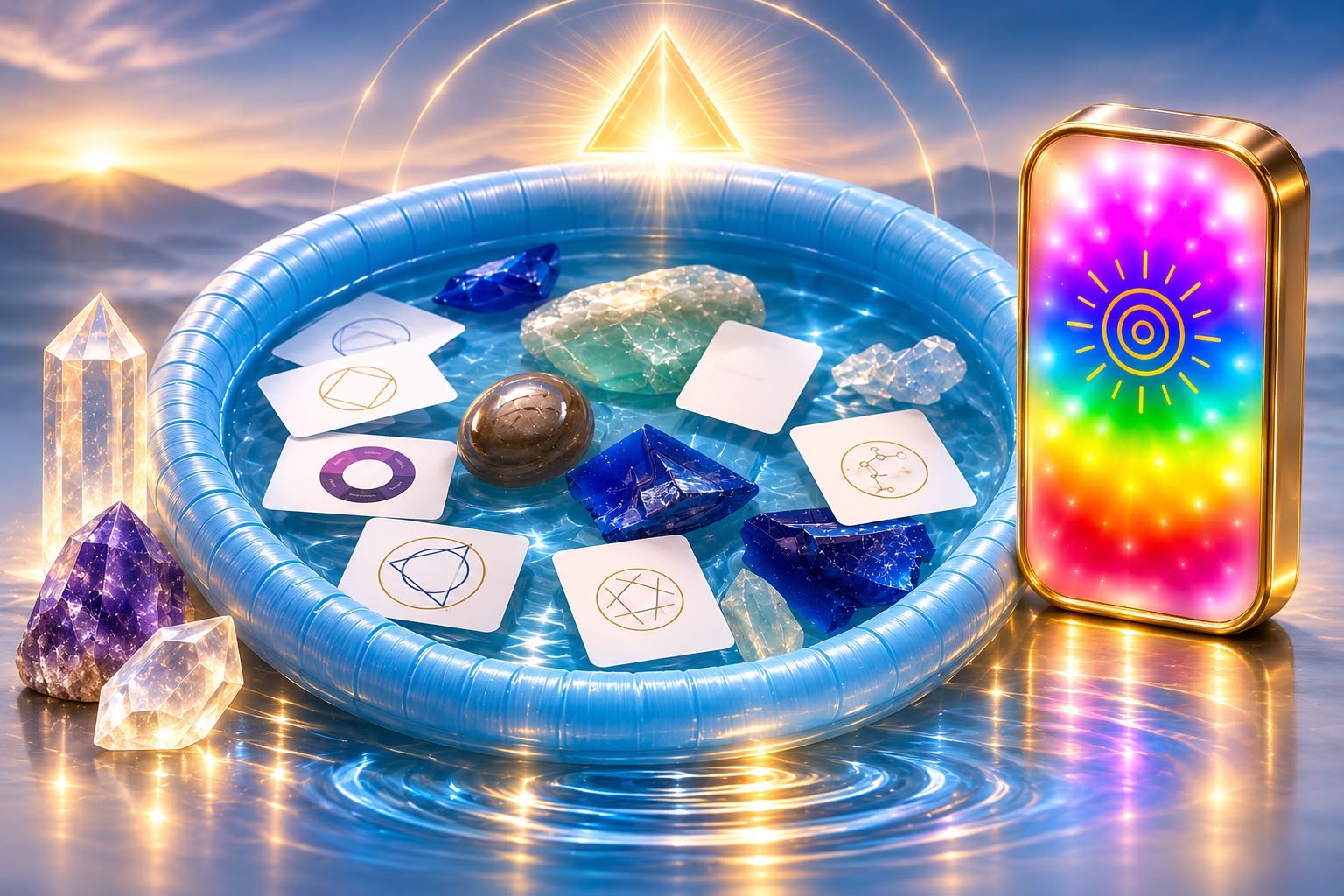
The originating practice combines water, codes, crystals and illumination, with floating arrangements forming part of the author's visual and experiential vocabulary [1]. Its scientific development requires more than an attractive image of movement. A floating object's trajectory, a physicochemical change and a person's experience are different observations. This paper preserves the proposal while dividing it into questions that can be measured or reported with appropriate methods.
Source boundary
The dossier describes Floating Triads as an observational practice and supplies a preliminary research agenda [1]. The seven-page Clase 3 del Agua source was located, but the recovered text contains the title, subtitle and a photo credit; the underlying visual instructions were not available as fully reviewed text. A complete original preparation sequence therefore remains a source gap. The protocol below is an editorial research proposal, not a claim that the historical method already contained these controls. Materials, dimensions, arrangement and handling must be checked against the original practice before replication.
Published background and its limits
Chai, Yoo and Pollack investigated illumination-related changes near a hydrophilic interface [2]. Their work concerns specified laboratory conditions and does not test Floating Triads, sacred codes or intention transfer. Florea and colleagues showed that ion exchange, diffusion and diffusiophoresis could explain long-range colloid repulsion in their system [3]. Taken together, these sources justify examining interfaces and chemical gradients while keeping alternative mechanisms explicit. They do not establish that ordinary movement in a bowl indicates a new water phase or a stored intention.
A staged physical evaluation
First document water source, preparation, volume, container geometry and material, temperature, time since preparation, illumination, object composition, dimensions, mass and placement. Use a stable camera and fixed reference scale to record trajectories over a prespecified interval. Record drafts, vibration, handling and exposure to heat. Candidate comparisons include water and objects without a code, a material-matched pattern comparison, and a controlled illumination change. Alter one declared component at a time unless the explicit question concerns the entire arrangement. Randomized run order and coded videos would reduce selective handling or interpretation.
Outcomes and analysis
Define movement outcomes before recording: displacement, speed, rotation or distance between objects, together with the image-analysis method. Repeated frames are not independent experimental runs; the unit of replication should be the separately prepared trial. Temperature, pH or conductivity may be useful context, but none alone proves molecular restructuring. Blinded trajectory scoring, repeated preparations and reporting of stable or null runs would help determine reproducibility. Any claim about chemical composition or optical structure needs an instrument selected for that property rather than an inference from visible motion.
Experience and conclusion
If the practice is later studied with participants, record instructions, prior expectations, perceived meaning, comfort and unfavorable experiences separately from the physical experiment. Meaningful symbolism can be described as experience without relabeling it as a water measurement. Conversely, a bench effect would not by itself demonstrate a wellbeing effect. The immediate contribution is a partitioned research agenda. Its limitations include incomplete original procedural recovery and the absence of an experimental dataset; no intention-storage, healing or neuronal mechanism is established.
Authorship and disclosures
Ana Silvia Lara develops the concepts, methods and products discussed and is associated with the publisher. No participant dataset was analyzed for this draft. Proposed studies have not been conducted through this work. The author is responsible for the final work. This working paper has not undergone independent peer review.
The inaugural journal issue is planned for March 2027. This working paper was released separately in November 2026. No ISSN, DOI, indexing status or institutional endorsement is claimed.
Conceptual sources and lineage
The author identifies De Akashico a Neuroakashico and Manifestación acelerada as conceptual antecedents of the relationship she proposes among intention, codes, light and experience [4, 5]. This establishes the provenance of the practice's vocabulary, without treating those works as experimental confirmation of a change in water or a clinical effect.
References
- Lara AS. Neuroconsciousness Journal Editorial March 2027. English design and manuscript review proof. Version 2; November 2026. Unpublished development dossier; relevant article identified in text.
- Chai B, Yoo H, Pollack GH. Effect of radiant energy on near-surface water. Journal of Physical Chemistry B. 2009;113(42):13953-13958. https://doi.org/10.1021/jp908163w
- Florea D, Musa S, Huyghe JMR, Wyss HM. Long-range repulsion of colloids driven by ion exchange and diffusiophoresis. Proceedings of the National Academy of Sciences. 2014;111(18):6554-6559. https://doi.org/10.1073/pnas.1322857111
- Lara AS. De Akashico a Neuroakashico: El nacimiento de la Luz Ilimitada. Ana Silvia Lara Publishing LLC; 2026. Author-supplied paperback manuscript, pp. 190-195.
- Lara AS. Manifestación acelerada. n.d. Book identified by the author as a conceptual source; edition and publication year not supplied.